
Alabama Bench Warrants Explained
A bench warrant in Alabama is process a judge signs in a case already on the docket. Miss a required appearance and one may follow. So can disregarding a court order. But the trigger does not work the same in every case, because the notice, the charge, the court rule, and the judge's own order all shape the result. A fine, a payment plan, or some other condition can matter too, and its effect is case-specific. One caution is worth repeating. A missed date does not prove a warrant issued, and the docket may never use the words "bench warrant" at all. Alabama records sometimes say warrant of arrest or alias warrant instead, and municipal courts keep local labels of their own. Ask the issuing Alabama court what was ordered and what step clears it now. That answer beats any guess about terminology.
An Alabama Bench Warrant May Follow a Missed Date
Missed an Alabama court date? Find the ticket, summons, bond paper, or case notice first, and read which court set it. Then call the clerk, magistrate, or municipal court before assuming a warrant issued. Ask for the current docket status. Ask whether the judge wants a new date, a motion, an appearance, or bond. A sheriff's list can be a useful lead, but it never replaces the court's answer. For Alabama traffic cases, the Traffic Service Center handles eligible ticket resolutions, yet its payment flow is not a warrant-clearance process, and paying may waive trial or count as a plea in eligible matters. Once the court acts, keep the order or receipt. Ask whether separate agency records still need an update, since one office's fix does not always reach the other.
Note: Alabama sets no statewide grace period before a missed date turns into warrant process.
How Alabama Bench Warrants Are Issued
What happens after a missed obligation depends on the Alabama case court. Alabama Rule of Criminal Procedure 3.1 supplies the framework for a warrant or summons in criminal proceedings. It permits a summons in eligible circumstances. A warrant may follow when the rule's conditions are met, including specified failures to appear or to serve the summons. The judge or magistrate weighs the rule against the facts and makes the call.
The basic Alabama process is: court obligation missed → judicial review of the case → summons, warrant, or other order as authorized → local service and return. Alabama Rule 18 of Judicial Administration describes magistrate functions that can include warrant and bail or release duties within delegated authority. AOC’s internal WMS supports electronic warrant processing, but annual reports do not say whether every bench warrant enters a public-facing system. An Alabama warrant remains a court matter until the court changes or recalls it.
Alabama Rule 3.1 explains the warrant-or-summons framework.
Alabama Court Tiers Issue Different Warrants
The court tier follows the case, not the county's general website. Circuit Court is Alabama's felony trial court and its court of general jurisdiction. District Court takes county misdemeanors, preliminary felony proceedings, and other statutory matters. Municipal Court handles city ordinance cases plus assigned traffic or misdemeanor matters within its limits. The clerks mirror that split. Alabama Circuit Clerks administer Circuit and District Court records through division-specific staff. Municipal clerks keep the city-court dockets. Probate Court has only limited statutory duties and is not the ordinary criminal warrant court. One wrinkle trips people up. A city citation can stay with municipal court even though the city sits inside a county, so a county sheriff's list may not show the whole case.
Note: Identify the Alabama court named on the notice before using a general county case search.
Bench and Arrest Warrants Compared
Both papers can authorize an arrest. Alabama law just treats their origins differently. A bench or failure-to-appear warrant grows out of an existing court matter or an unmet order. An arrest warrant starts with judicial process on an alleged offense, usually after a probable-cause determination. The label alone tells you neither the case status nor the next step.
| Feature | Bench Warrant | Arrest Warrant |
|---|---|---|
| Typical basis | Missed appearance or unmet Alabama court order | Probable cause for an alleged offense |
| Case setting | An existing Alabama court matter | A criminal charge or indictment |
| Issuing authority | Alabama judge or authorized judicial officer | Judge or magistrate under Rule 3.1 |
| Next step | Ask the Alabama court about appearance, motion, or bond | Confirm the charge, court, service agency, and release terms |
A bench warrant in Alabama is not a new conviction. For the separate probable-cause process, see Arrest Warrant Search. Either way, the issuing Alabama court controls its order, and the local agency handles its assigned service information.
Alias and Capias Terms in Alabama Warrant Records
Alabama forms and municipal court schedules use "alias" and "capias" in particular contexts, yet the state uses no single label for all missed-date warrants. Ala. Code § 15-10-60 uses "bench warrant" narrowly, for a person accused by a grand jury. Treat the term accordingly, not as a universal name for every failure-to-appear order.
- Failure to appear
- A missed required appearance in an Alabama court; the case and order determine the consequence.
- Alias warrant
- A term used on some Alabama forms or court schedules; verify the docket entry.
- Capias
- An Alabama capias is a writ or process term whose meaning depends on the court and legal basis.
- Capias pro fine
- Alabama process that may relate to fine enforcement; confirm the actual order and statute.
- Recall or quash
- A court action withdrawing or setting aside process; a request alone does not cancel it.
When you speak with the clerk, use the exact label from the Alabama case record. A familiar word does not guarantee the order carries the same effect in every court.
Resolving an Alabama Bench Warrant
Only the issuing Alabama court can recall or quash its warrant. A clerk can explain the filing steps and record access, but cannot promise how a judge will rule. Before you visit an office, ask whether the court expects a motion, an appearance, bond, or something else. Alabama has no uniform statewide walk-in surrender guide or standard counter hours, so check first.
- Confirm the issuing Alabama court, case number, current warrant order, and next required action.
- Ask whether an Alabama court will accept a motion to recall or quash, a new date, an appearance, or bond.
- Consider Alabama counsel before contact or travel if arrest may occur or pre-service information is restricted.
- Follow the Alabama court’s instructions, then keep the order or receipt and ask about separate agency updates.
Caution: Do not assume an old Alabama bench warrant expired on its own; reviewed sources found no general automatic expiration period for this process.
Bond terms in Alabama depend on the order and the case. An Alabama bond is not a fine. Paying a ticket or satisfying a separate license requirement does not itself recall a warrant.
Alabama Bench Warrant Bond Terms Depend on Court
Bond on an Alabama bench warrant is set case by case. Alabama Rule 7.2 carries a general bail schedule for Circuit, District, and Municipal Courts, but it is not a warrant price list. The real release terms hinge on the charge, the court order, and the facts. Call the issuing clerk or the local sheriff first. Ask what bond amount applies and which payment methods that office accepts. Alabama courts differ on this. Bond also stands apart from fines, court costs, or an ALEA license reinstatement fee. When a traffic citation started the case, the Traffic Service Center's resolution options are case-specific and can affect the plea or trial right. Alabama Rule 7.6 covers filing and transfer of an appearance bond plus a surety's surrender process; it is not a guide to surrendering yourself. Alabama sets no statewide warrant bond amount, recall fee, or uniform walk-in procedure. The judge sets the terms for your case, and only that court can quote them.
Finding the Court That Issued It
In Alabama, the issuing court controls the docket, warrant order, and any recall. The Alabama Circuit Clerk keeps Circuit and District Court records; the municipal court clerk keeps city-court records. A sheriff may know the service status but cannot substitute for the judge’s decision. Read the case notice or citation to identify the city, county, division, and case number.
Use the County Directory to locate the county court and sheriff for an Alabama case. For copies, ask the custodian about a narrow request under the Alabama Open Records Act; access limits still apply. Etowah County Circuit Clerk’s local request page gives one example of copy and search fees, which apply only to that office. If the matter began with a city citation, contact that municipal court as well. When the city or county is unclear, use the Alabama Secretary of State city and county lookup rather than guessing.
Note: A county court search may not show a separate Alabama municipal docket or its local warrant entry.
City Court Warrants Stay With Their Court
Alabama municipal courts handle city ordinance matters plus traffic and misdemeanor cases assigned to them. Some Alabama city portals offer a case or warrant-number lookup, but each one covers only its own city. Troy's court links a public portal the city says can show an active warrant. Alabaster posts a local alias or capias search. Those are local tools, not one statewide municipal system. Troy's public court portal and Alabaster's city warrant information are the official channels for each. For any Alabama city matter, contact the municipal clerk and the agency assigned to serve the warrant. Birmingham's municipal-court information describes its warrant and bail duties for Alabama cases, though its case portal is not labeled a warrant-status search. Confirm the court and case number before assuming anything from an Alabama county list or a city search result. Huntsville Municipal Court publishes local warrant and bail information, one Alabama example of a city court laying out its own guidance.
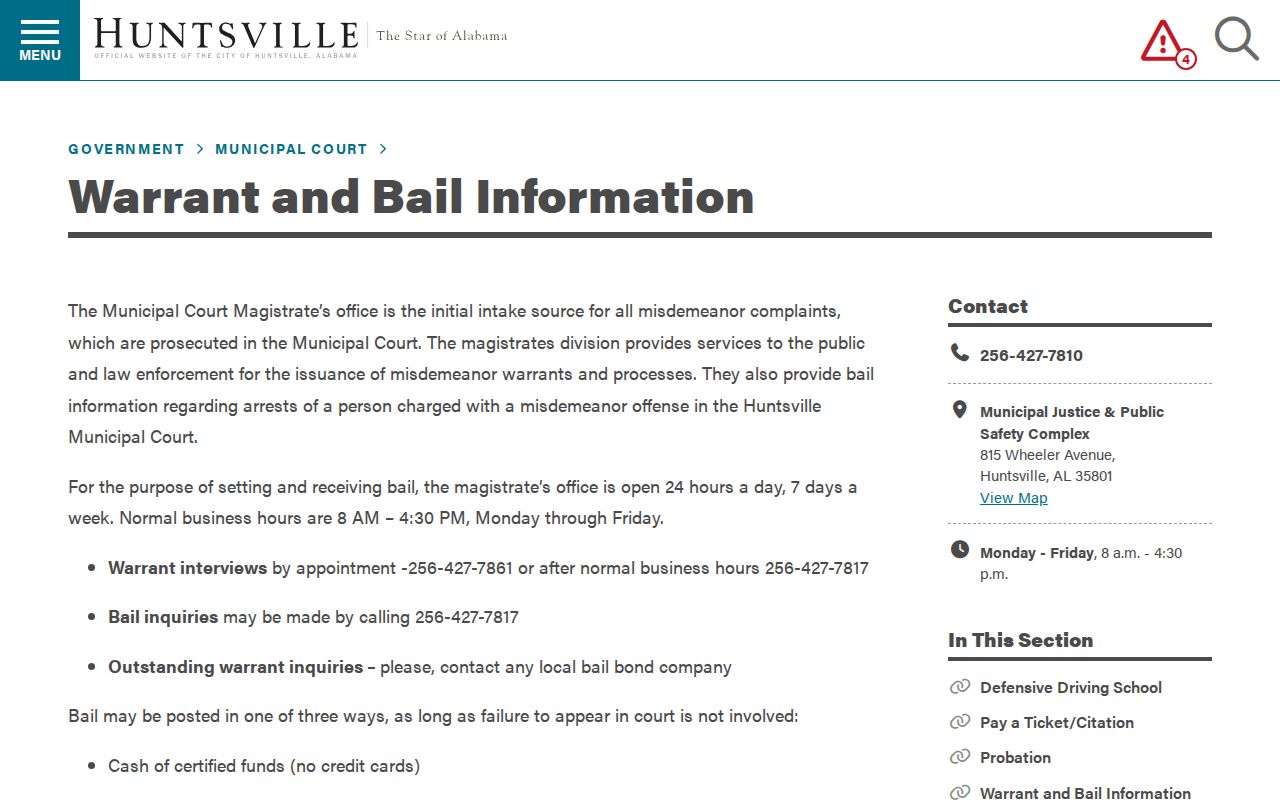
This Alabama page from Huntsville lists that municipal court's own warrant and bail contacts and hours. Those details apply to Huntsville's court, not to a statewide procedure or public roster.